
Understanding the Insurance Company’s Medical Exam Request in Your Georgia Claim
Key Takeaways: An insurer-scheduled medical exam in a Georgia workers’ compensation claim is generally an employer-directed evaluation under O.C.G.A. § 34-9-202, not neutral treatment. The doctor is typically designated and paid by the employer or State Board. The visit is usually brief and focuses on causation, reasonableness of treatment, maximum medical improvement, impairment ratings, and work restrictions, and may include physical, psychiatric, and psychological components. The resulting report, not the appointment itself, is generally what adjusters use to decide on continuing, changing, or terminating benefits. Preparation matters: arrive early, answer honestly about prior injuries, and note arrival times and which body parts were actually examined. Injured workers with accepted compensable injuries may also hold a separate statutory right to one examination by a physician of their own choosing, paid by the employer, generally within 120 days of receiving income benefits and subject to notice, cost, and location conditions. Unreasonably refusing to attend a required exam may suspend the right to compensation for that period, so attending and raising concerns in writing is often the safer course.
When a workers’ compensation insurer schedules you for a medical evaluation with a doctor you did not choose, you are generally being sent to an employer-directed examination, not a neutral second opinion. Under O.C.G.A. § 34-9-202, after an injury and so long as you claim compensation, you may be required to submit to examination at reasonable times and places by a physician designated and paid for by the employer or the State Board of Workers’ Compensation. The visit is usually short and evaluative rather than therapeutic, and the resulting report can influence your restrictions, benefits, and whether the insurer continues to accept your claim.
If you have received a notice for an insurer IME and are unsure what it means for your benefits, the team at The Law Offices of Darwin F. Johnson is available to explain your options. Call 404-521-2667 or request a case review today to discuss your situation before the appointment date.

Why the Insurer Sends You to Its Own Doctor
Employer-requested exams generally serve an evaluative, not treatment, function. The insurer or self-insured employer may want a written opinion on whether your injury relates to your job, whether your treatment plan is reasonable, whether you’ve reached maximum medical improvement, and what work restrictions apply. Because the examining physician is designated and paid by the employer, the report is often used to support the carrier’s position.
That doesn’t mean the opinion is automatically accepted. An administrative law judge with the State Board weighs competing medical evidence as the finder of fact and may consider the treating physician’s longitudinal knowledge alongside a one-time evaluation. No opinion controls by rule, and outcomes are fact-dependent.
Common Situations That Trigger an Exam Request
Injured workers in Atlanta warehouses, construction sites, poultry plants, and hospitals frequently see these requests at predictable moments, such as when:
- Treatment has continued longer than the adjuster expected
- Surgery or an expensive diagnostic study has been recommended
- Your authorized treating physician has assigned significant restrictions
- A permanent partial disability rating is about to be assigned
- The carrier is considering suspending or contesting income benefits
What Happens During the IME Appointment Process
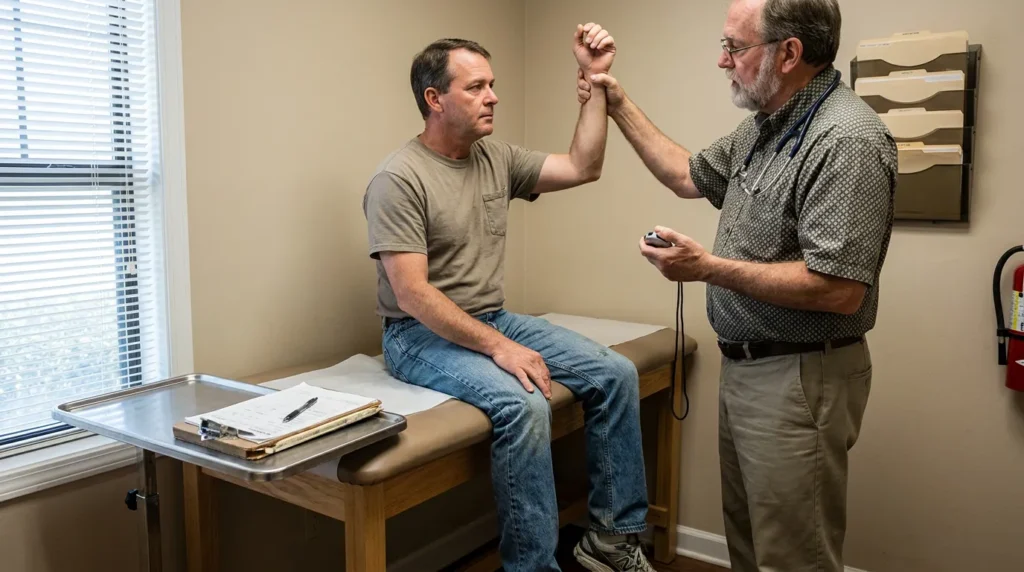
The appointment usually follows a predictable sequence. You’ll typically complete intake paperwork describing the accident, symptoms, and medical history, then meet briefly with the physician for a history discussion and physical evaluation. Many IME visits last less than an hour, since the physician is reviewing records rather than building a treatment relationship.
The doctor may test range of motion, strength, and pain response, and ask how the injury happened in your own words. Examinations may include physical, psychiatric, and psychological components, so the scope may be broader than expected when a claim involves depression, anxiety, or cognitive symptoms following workplace trauma.
Practical Preparation for a Workers’ Comp Exam in Georgia
Preparation matters more than performance. Arrive early, bring a photo ID and a written list of your medications and prior treatment, and be ready to describe a typical day with your injury. Answer honestly, including about prior injuries to the same body part, because inconsistencies between your statements and medical records are frequently the focus of the resulting report.
💡 Pro Tip: Write down the time you arrived, the time the physician entered and left the room, and which body parts were actually examined. A short contemporaneous note can become meaningful evidence if the report later describes testing that didn’t occur.
Independent Medical Examination Workers Comp Georgia Rules You Should Know
Georgia law recognizes more than one type of examination, generally operating under different rules. The employer’s right to compel an evaluation is separate from the injured worker’s own right to obtain an opinion. Confusing the two is one of the most common misunderstandings in Georgia workers’ compensation IME rules and can cost a worker a valuable statutory right.
Under O.C.G.A. § 34-9-202, an employee whose injury has been accepted as compensable generally has the right, within 120 days of receipt of any income benefits, to one examination at a reasonable time and place, within Georgia or within 50 miles of the employee’s residence, by a physician designated by the employee and paid for by the employer. That right requires advance written notice to the employer or insurer, and the examination may not repeat diagnostic procedures performed since the date of injury unless the cost of procedures exceeding $250.00 is paid by a party other than the employer or insurer.
| Feature | Employer-Requested Exam | Employee-Selected Exam |
|---|---|---|
| Who picks the doctor | Employer, insurer, or the Board | The injured employee |
| Who pays | Employer or insurer | Employer or insurer |
| Timing | While compensation is claimed | Generally within 120 days of receiving income benefits |
| Location limits | Reasonable time and place | In Georgia or within 50 miles of the employee’s residence |
| Scope | Evaluation of disputed medical issues | May include physical, psychiatric, and psychological examinations |
The 120-day period is a frequent trap because it generally runs from receipt of income benefits, not the date of the accident. Workers who wait may lose the opportunity, though parties sometimes agree to an evaluation outside it. For a fuller breakdown, this explanation of what an independent medical exam is walks through the basics.
A Different Process Applies to Occupational Disease Claims
Occupational disease claims generally follow their own path. When medical questions are in controversy, the parties may agree to refer the employee to a licensed physician with unique knowledge of the disease for an independent medical examination and report, and the Board may become involved if the parties cannot agree. The selected physician files written findings with the Board as soon as practicable, and no later than 60 days after the examination or autopsy is completed. That deadline applies to the examining doctor, not the worker, which is why this process should not be confused with the 120-day self-request right.
What to Expect at an IME Report and How It Gets Used
The report, not the appointment, is typically what affects your claim. The physician typically produces a narrative addressing causation, diagnosis, appropriateness of treatment, maximum medical improvement, impairment rating, and work capacity. Adjusters may rely on it to support changing or terminating benefits, though benefits generally may not be unilaterally suspended except as permitted by the Act and Board rules, and disputes are resolved through State Board procedures rather than a civil lawsuit.
You or your attorney may generally request a copy of the report. Reviewing it carefully matters, because factual errors about your job duties, the mechanism of injury, or your prior medical history can often be rebutted with records, witness statements, or a supplemental opinion from your treating physician. Guidance published by the Georgia State Board of Workers’ Compensation addresses common questions about medical treatment rights under the Act.
Risks of Skipping the Appointment
Refusing to attend a required examination can carry real consequences. Georgia law provides that proceedings may be suspended and the employee’s right to compensation may be suspended for any period during which the employee unreasonably fails or refuses to submit to such an examination. Whether a refusal is unreasonable is fact-dependent, and legitimate issues like lack of notice, an unreasonable time or location, or a genuine scheduling conflict may be raised for the Board’s consideration.
The safer course in most cases is to attend and document concerns rather than simply not appear. If the location seems unreasonable or transportation is a barrier, raise the issue in writing promptly. An Atlanta workers comp IME lawyer can help address scheduling objections through the proper channels.
💡 Pro Tip: Bring a trusted adult with you to the waiting room. Even if the companion cannot enter the exam room, a witness to arrival time and general visit length can corroborate your account later.
Frequently Asked Questions
1. Do I have to attend an exam scheduled by the insurance company?
Generally yes. The statute contemplates that an employee claiming compensation submits to examination at reasonable times and places by a qualified physician designated and paid by the employer or the Board, and unreasonable refusal may result in suspension of the right to compensation for that period. Concerns about reasonableness should be raised promptly and in writing rather than by skipping the visit.
2. Can I bring someone with me to the IME doctor evaluation?
Practices vary by provider, and the examining office may limit who enters the exam room. Many workers bring a family member for transportation and support. If you have a specific need, such as an interpreter or a mobility aid, notify the scheduling contact in advance.
3. Is the insurer’s doctor the same as my own independent medical examination?
Generally no. The employer-directed evaluation is typically distinct from the one examination an injured worker with an accepted compensable injury may generally request under O.C.G.A. § 34-9-202 within 120 days of receiving income benefits, using a physician the worker selects at the employer’s expense, subject to the statute’s notice, cost, and geographic conditions.
4. What if the report contradicts my treating physician?
Conflicting medical opinions are common in contested claims. The Board weighs the evidence, and factors such as depth of record review, the treating relationship, and internal consistency may influence how much weight an opinion receives. Results depend heavily on the specific facts and documentation.
5. Does attending mean I accept the doctor’s conclusions?
Attending an examination generally does not waive your ability to dispute the findings. You may generally present additional medical evidence, request a hearing, and challenge inaccuracies through State Board procedures.
Protecting Your Claim Before and After the Exam
An insurer-scheduled evaluation is a normal part of many Georgia workers’ compensation claims, and it isn’t necessarily a sign your case is lost. Understanding the purpose of the visit, preparing accurate information, documenting what occurred, and knowing that a separate statutory right may exist to obtain your own examination within 120 days of receiving income benefits can meaningfully strengthen your position. Because statutory deadlines are generally applied as written and every claim turns on its own facts, early guidance is often valuable.
If an examination has been scheduled or a report has already affected your benefits, The Law Offices of Darwin F. Johnson can review your claim and discuss next steps. Call 404-521-2667 or reach out to our team now to get answers about your rights.
Disclaimer: This content is for informational purposes only and is not legal advice. Every case is unique, and results may vary. Consult an attorney about your specific circumstances.