

Understanding Wage Benefits After a Workplace Injury in Atlanta
Key Takeaways: Yes, injured Atlanta workers can generally receive income while recovering because Georgia’s no-fault workers’ compensation system replaces a portion of lost wages without requiring proof of employer fault. Eligible employees may qualify for medical, rehabilitation, and income benefits paid through the employer’s insurer. Wage benefits are calculated as two-thirds of your average weekly wage, capped at $800.00 per week for total disability and $533.00 per week for partial disability. Most benefits last up to 400 weeks (350 for partial disability), but catastrophic injuries can extend coverage beyond standard caps. Payments typically begin after seven days of missed work, with your first check due within 21 days.
Yes, in most cases injured Atlanta workers can receive income while recovering from a job injury. Georgia’s workers’ compensation system replaces a portion of your wages when a workplace injury keeps you off the job or limits your earnings. The law provides specific benefits for injuries arising out of and in the course of employment, without regard to negligence or fault. This no-fault structure means you generally don’t need to prove employer wrongdoing to qualify for benefits.
The answer to "if i get injured at work do i get paid" depends on your wages, injury severity, and whether you can return to work. The Law Offices of Darwin F. Johnson helps injured workers across Atlanta and Georgia counties pursue owed benefits. Reach out through our Atlanta legal team, call us at 404-521-2667, or use our online consultation request to discuss your situation.
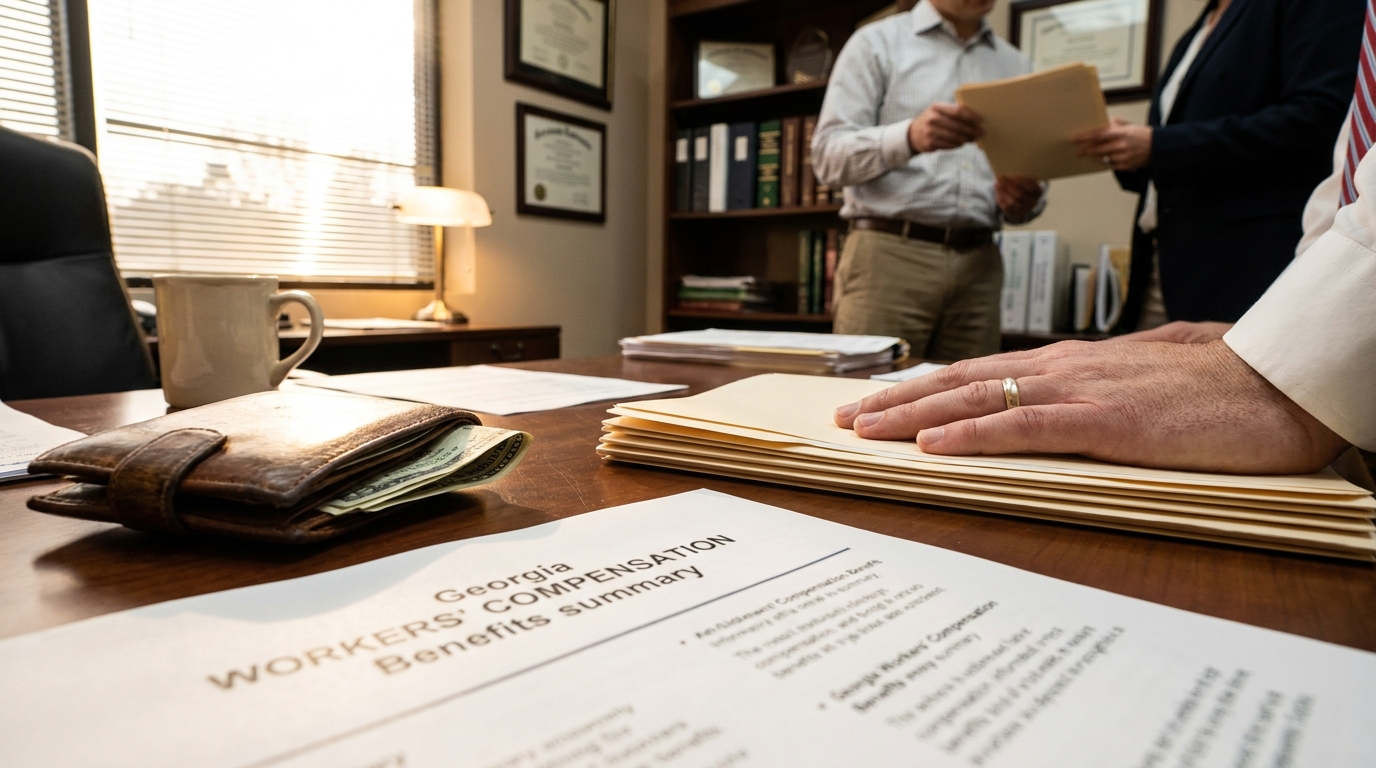
If I Get Injured at Work Do I Get Paid Under Georgia Law?
Georgia workers’ compensation provides three categories of benefits to employees hurt on the job. Workers’ compensation is an accident insurance program paid by your employer which may provide medical, rehabilitation and income benefits if you’re injured on the job. The income benefits portion is what most workers consider "getting paid" while recovering, paid by the employer’s insurer.
These protections apply broadly across Georgia workplaces. The law applies to all employers, including public corporations and nonprofit organizations with at least three full-time or part-time employees. If you work for a qualifying employer in construction, trucking, warehouse logistics, healthcare, poultry processing, or retail, you may be entitled to benefits, subject to eligibility requirements. Certain workers such as farm laborers, domestic servants, and railroad employees are excluded from coverage. Learn more about available benefits through this overview of job injury pay Atlanta workers may recover.
💡 Pro Tip: Report your injury promptly and in writing. Georgia expects injury reporting within 30 days, and delayed reporting is a common reason insurers question claims.
How Much You May Receive While Recovering
The amount you receive depends on your average weekly wage and your ability to work. Georgia law calculates wage-replacement benefits as a percentage of your pre-injury earnings, then applies a statutory cap. Understanding which category fits your situation helps anticipate your income during recovery.
Total Disability Benefits
If you’re completely unable to work, you may qualify for temporary total disability benefits. Under GA Code § 34-9-261, an injured worker who is temporarily and totally disabled is entitled to two-thirds of their average weekly wage, capped at $800.00 per week with a $50.00 floor (or actual weekly wage if less). You receive two-thirds of your average weekly wage, but not more than $800.00 per week for accidents occurring on or after July 1, 2023. Payments generally continue for up to 400 weeks from the injury date, subject to catastrophic exceptions. Review the statutory text on temporary total disability benefits for context.
Partial Disability Benefits
Workers who can perform some work at reduced earnings may qualify for partial benefits. Under GA Code § 34-9-262, when disability is partial but temporary, the employer pays a weekly benefit equal to two-thirds of the difference between your pre-injury average weekly wage and post-injury earnings. This temporary partial benefit is capped at $533.00 per week and may continue for up to 350 weeks from the injury date. If you remain on light-duty restrictions for 52 consecutive weeks or 78 aggregate weeks, total disability benefits may convert to partial disability benefits. You may receive income benefits even after returning to work.
💡 Pro Tip: Keep copies of every pay stub before and after your injury. Your average weekly wage drives the calculation, and accurate records help prevent underpayment.
| Benefit Type | Statute | Weekly Cap | Maximum Duration |
|---|---|---|---|
| Temporary total disability | § 34-9-261 | $800.00 | Up to 400 weeks |
| Temporary partial disability | § 34-9-262 | $533.00 | Up to 350 weeks |
| Catastrophic injury | § 34-9-200.1 | $800.00 | Until improvement |
How Long Georgia Workers’ Comp While Recovering Can Last
Benefit duration depends largely on whether your injury is classified as catastrophic. For most non-catastrophic claims, wage benefits and medical care are time-limited. If your accident occurred on or after July 1, 1992, you’re entitled to benefits for up to 400 weeks. If your injury is catastrophic, you may receive lifetime benefits.
Medical treatment carries its own timeline. For accidents on or after July 1, 2013, medical treatment is available for up to 400 weeks. For catastrophic injuries, medical coverage may extend for the worker’s lifetime.
Catastrophic Injuries and Extended Pay
A catastrophic injury removes the standard 400-week cap on income benefits. Under GA Code § 34-9-200.1(g), Georgia law defines catastrophic injury to include:
- Spinal cord injury causing severe paralysis of an arm, leg, or trunk
- Amputation of an arm, hand, foot, or leg with effective loss of use
- Severe brain or closed head injury
- Second or third degree burns to 25 percent or more of the body, or third degree burns to 5 percent or more of the face or hands
- Total or industrial blindness
- Any other injury of a nature and severity that prevents the employee from being able to perform his or her prior work and any work available in substantial numbers within the national economy for which such employee is otherwise qualified.
Catastrophic injuries change the benefit structure significantly. You’re entitled to receive two-thirds of your average weekly wage but not more than $800 per week for as long as you’re unable to return to work. Under § 34-9-261, payments continue until the worker undergoes a change in condition for the better, an issue often contested by insurers.
Benefits for a Worker’s Dependents
Georgia law provides income support when a job injury proves fatal. Under GA Code § 34-9-265, dependents wholly dependent on the deceased worker’s earnings receive weekly compensation equal to the total disability rate, while partial dependents receive a proportionate share. The employer must pay reasonable burial expenses not exceeding $7,500.00. Death benefits are subject to statutory limits, including a maximum total for a sole surviving spouse and the 400-week period of dependency.
When Payments Begin and Common Hurdles
Income benefits don’t start on the first day you miss work in most cases. You’re entitled to weekly income benefits if unable to work for more than 7 days. Your first check should be mailed within 21 days after the first day missed. If you miss more than 21 consecutive days, you’re paid for the first week.
Prior injuries can affect your benefits. Under GA Code § 34-9-241, a worker generally cannot receive income benefits for two separate injuries simultaneously, but is entitled to benefits from whichever injury covers the longest period and largest amount. When a later injury combines with prior disability to produce total disability, the worker may receive total disability benefits under § 34-9-261.
💡 Pro Tip: If an insurer denies your claim or pays less than expected, you can challenge that decision through the State Board of Workers’ Compensation. Review official guidance on Georgia workers’ comp benefits before deciding your next step.
Frequently Asked Questions
1. If I get injured at work do I get paid for the first week off?
Generally, the first seven days aren’t paid unless your absence is extended. You become entitled to weekly income benefits after missing more than seven days, with the first week paid only if you’re out more than 21 consecutive days.
2. Can I still get paid if I return to light-duty work?
Yes, you may receive partial benefits after returning to work. Under § 34-9-262, if you earn less than before due to your injury, you may collect two-thirds of the difference, capped at $533.00 per week.
3. How long can I receive Atlanta work injury recovery benefits?
Most income benefits last up to 400 weeks, though some are shorter. Temporary partial benefits may run up to 350 weeks, while catastrophic injuries may qualify for benefits with no fixed cap. Your treating physician’s findings and injury classification heavily influence duration.
4. What counts as a catastrophic injury in Georgia?
Catastrophic injuries include severe conditions defined by statute. Under § 34-9-200.1(g), examples include severe paralysis, limb amputation, serious brain injury, extensive burns, and total blindness. Designation is often disputed and may require medical and vocational evidence.
5. Do I need to prove my employer was at fault?
No, Georgia operates a no-fault workers’ compensation system. Benefits are provided without regard to negligence, as long as the injury arose out of and in the course of employment.
Protecting Your Right to Recovery Pay
Getting paid while recovering from a job injury in Atlanta is a statutory right, but not automatic. From calculating your average weekly wage to meeting reporting deadlines and challenging improper denials, details matter, and insurers don’t always pay what injured workers are owed. Because outcomes depend on specific facts, guidance from a lawyer experienced in handling Atlanta workers comp wage benefits claims can help protect your income during a difficult time.
If you’ve been hurt on the job, don’t wait to understand your options. The Law Offices of Darwin F. Johnson is ready to review your claim and help you pursue the benefits Georgia law allows. Visit our firm’s website, call 404-521-2667, or schedule your consultation today to take the next step toward securing the benefits you deserve.