
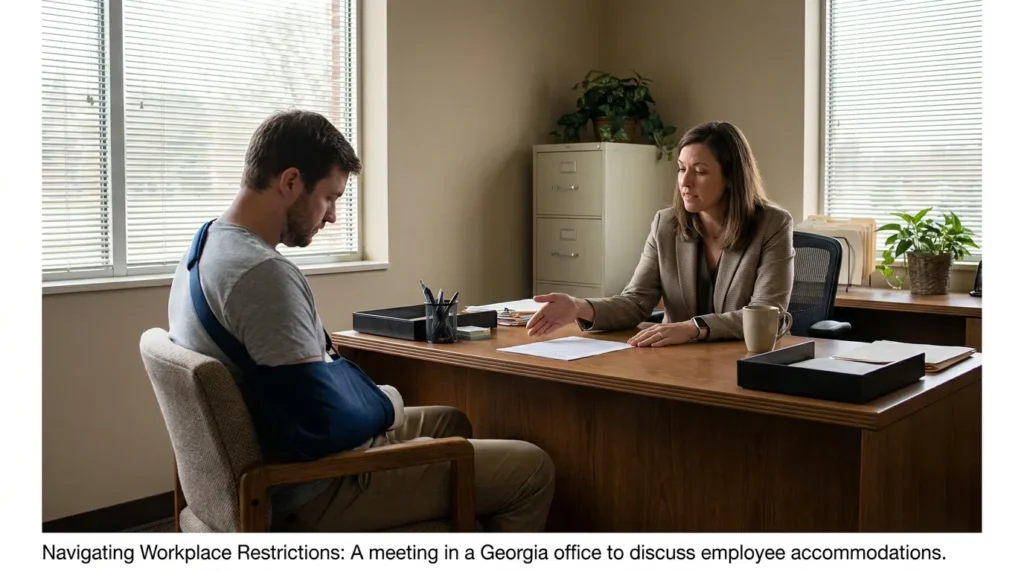
Your Rights When Light-Duty Work Is Not Available
Key Takeaways: If a Georgia employer cannot accommodate your work restrictions, it generally cannot suspend your weekly workers’ compensation benefits, because Georgia law ties light-duty suspension rights to a genuine, suitable job tender within your physician’s restrictions under O.C.G.A. § 34-9-240. When no valid offer exists, your checks should continue unless another lawful ground applies, and improperly stopping them can expose the employer to a 15 percent penalty under O.C.G.A. § 34-9-221(e). If you attempt offered work for at least eight hours but cannot sustain it within 15 days, benefits are reinstated and the burden falls on the employer, while refusing or barely attempting suitable work can shift that burden to you. The federal ADA may require your employer to consider reasonable accommodations, and even a doctor’s note releasing you to light duty can count as a request. Your weekly benefit amount rests on your average weekly wage, with a fairness alternative for irregular schedules. Consulting a knowledgeable Georgia workers’ compensation attorney can help protect your income.
When an Atlanta employer cannot bring you back to a job that fits your medical limits, your weekly workers’ compensation checks generally must continue. Georgia’s workers’ compensation system ties an employer’s ability to suspend income benefits through a light-duty offer to whether it actually offers a suitable job within your restrictions. If the authorized treating physician releases you to work with restrictions and the employer tenders a suitable job within those restrictions, the suspension mechanism may be triggered. Absent a valid job offer, the employer has no grounds to stop payments.
If you are facing an employer who claims it has no light-duty position for you, contact The Law Offices of Darwin F. Johnson today. Call our team at 404-521-2667 or reach out through our online contact page to discuss your situation.

What If an Employer Cannot Accommodate Work Restrictions Under Georgia Law
The central rule is straightforward: an employer that cannot place you in a suitable job within your restrictions generally cannot unilaterally cut off your weekly benefits through the light-duty mechanism. Georgia’s light-duty suspension framework only activates when a real, suitable job is tendered. Under O.C.G.A. § 34-9-240(b), the statute’s suspension rights arise only after the employer "tenders a suitable job" within the physician’s restrictions. If that tender never happens, your weekly checks should continue unless the employer has a separate lawful basis to suspend or controvert benefits.
Some employers and insurers attempt to stop payments simply by asserting there is no work available. The law does not reward that approach. The absence of a suitable offer leaves the insurer obligated to keep paying unless another valid ground for suspension exists. You can review the controlling text in the Georgia Code § 34-9-240 when evaluating whether your employer followed the rules.
💡 Pro Tip: Keep a copy of every work-status note your treating physician issues. These documents establish your restrictions and become key evidence if an insurer claims a job was "suitable" when it was not.
When Benefits Continue and When They Can Be Suspended
Whether your benefits continue often turns on what the employer offers and how you respond to a legitimate offer. Georgia law treats a genuine, suitable job offer very differently from a situation where no offer exists.
If You Try a Light-Duty Job but Cannot Sustain It
Georgia gives injured workers a meaningful window to attempt offered work without forfeiting benefits. Under O.C.G.A. § 34-9-240(b)(1), if you attempt the offered job for eight cumulative hours or one scheduled workday, whichever is greater, but cannot perform it for more than 15 working days, weekly benefits shall be immediately reinstated, and the employer carries the burden to prove you are not entitled to continuing benefits.
If You Refuse or Barely Attempt a Suitable Job
Refusing genuinely suitable work, or abandoning it too quickly, can shift the legal burden onto you. Under O.C.G.A. § 34-9-240(b)(2), if you attempt the job for less than eight cumulative hours or refuse to attempt it, the employer may unilaterally suspend benefits by filing the appropriate form with the State Board of Workers’ Compensation, and the burden shifts to you to prove continuing entitlement. This provision applies only when a real, suitable job within your restrictions was actually offered.
A broader risk exists for refusing suitable employment outright. Under O.C.G.A. § 34-9-240(a), if you refuse employment procured for you and suitable to your capacity, you shall not be entitled to any compensation during the continuance of that refusal, unless the Board finds the refusal was justified.
| Scenario | Effect on Weekly Benefits | Who Carries the Burden |
|---|---|---|
| No suitable job offered | Benefits generally continue | Employer |
| Job attempted 8+ hours, fails within 15 days | Benefits reinstated immediately | Employer |
| Job refused or attempted under 8 hours | Benefits may be suspended | Employee |
💡 Pro Tip: Before turning down any offered position, get clarity in writing on the job duties and hours. A position that exceeds your medical restrictions may not be "suitable," which can change the legal analysis entirely.
How the ADA and Reasonable Accommodation Fit In
Separate from workers’ compensation, the federal Americans with Disabilities Act may require your employer to consider reasonable accommodations. The ADA, codified at 42 U.S.C. §§ 12101-12117, addresses accommodation differently than Georgia’s wage-benefit statute, so both can be relevant simultaneously.
You do not have to use legal buzzwords to ask for help. According to EEOC guidance, a letter stating you are released to light duty constitutes a request for reasonable accommodation. Requests need not be in writing and may be made in conversation or by other means.
Reasonable accommodations under the ADA can take several forms. The EEOC’s reasonable accommodation guidance lists options that may apply to injured workers:
- Job restructuring to remove non-essential tasks
- A modified or part-time schedule
- Modified workplace policies
- Reassignment to a vacant position as an accommodation of last resort
An employer may decline an accommodation in limited circumstances. An employer can refuse if the accommodation would cause "undue hardship," weighing factors such as cost, disruption to operations, and impact on the work environment. The ADA generally applies to employers with 15 or more employees, and outcomes are fact-specific.
💡 Pro Tip: If you submit a doctor’s note with restrictions, keep proof of the date you delivered it. That timestamp can matter if your employer later disputes when it learned of your need for accommodation.
How Your Weekly Benefit Amount Is Calculated
When benefits must continue because no suitable job exists, the amount generally rests on your average weekly wage. Under O.C.G.A. § 34-9-260(1), if you worked substantially the whole of the 13 weeks immediately preceding the injury, your average weekly wage is one-thirteenth of the total wages earned during those 13 weeks. This standard method produces the wage base for your weekly check, which is then generally paid at two-thirds of the average weekly wage, subject to the statutory maximum.
Georgia law includes a fairness valve for workers who do not fit the standard formula. Under O.C.G.A. § 34-9-260(3), if the standard methods cannot reasonably and fairly be applied, the full-time weekly wage shall be used. This provision often helps newer employees and those with irregular schedules avoid artificially reduced benefits.
Penalties When an Employer Wrongly Stops Payments
Georgia attaches financial consequences when an employer improperly halts benefits. Under O.C.G.A. § 34-9-221(a), income benefits shall be paid periodically, promptly, and directly to the person entitled thereto, without an award, except where liability is controverted by the employer.
A late or wrongful nonpayment can trigger an automatic penalty. Under O.C.G.A. § 34-9-221(e), if income benefits payable without an award are not paid when due, a 15 percent penalty is added to the accrued unpaid benefits, unless a notice to controvert is filed or the Board excuses the nonpayment. Workers worried about losing their jobs after an injury can learn more about related protections and read about whether you can be fired while out on workers’ comp through our discussion of injured worker rights Georgia.
💡 Pro Tip: If your checks suddenly stop, ask whether a WC-2 or notice to controvert was filed with the State Board. The presence or absence of that filing often reveals whether the suspension was even arguably proper.
Frequently Asked Questions
1. What if an employer cannot accommodate work restrictions but stops my checks anyway?
An employer that cannot offer a suitable job generally has no statutory basis to suspend your weekly benefits through the light-duty mechanism. Under O.C.G.A. § 34-9-240(b), that suspension mechanism is triggered only by a valid job tender. Improperly stopping payments may expose the employer to the 15 percent penalty under O.C.G.A. § 34-9-221(e).
2. Does a doctor’s note count as requesting an accommodation?
Yes, in many cases. EEOC guidance treats a release to light-duty work as a request for reasonable accommodation, and such requests need not be in writing or phrased in legal terms.
3. Can I be forced to try a light-duty job?
You may be offered suitable work, and refusing genuinely suitable work can affect benefits. Under O.C.G.A. § 34-9-240(a), an unjustified refusal can suspend compensation during the refusal, subject to the Board’s review.
4. How is my weekly benefit calculated if my schedule was irregular?
Georgia provides a fairness alternative for irregular work histories. Under O.C.G.A. § 34-9-260(3), the full-time weekly wage may be used when the standard 13-week method cannot fairly apply.
5. Are workers’ compensation and ADA claims the same thing?
No, they are separate legal frameworks. Workers’ compensation is an administrative system governed by Georgia statute, while the ADA is a federal law addressing accommodation and undue hardship.
Protecting Your Income After an Inability to Accommodate
The bottom line is that an employer’s inability to provide light-duty work in Georgia generally protects, rather than ends, your right to weekly benefits. Georgia law ties light-duty suspension rights to a genuine job tender, calculates benefits on your average weekly wage, and imposes penalties for improper nonpayment. Because these matters are fact-sensitive and depend on documentation and timing, working with a knowledgeable Georgia workers comp lawyer can help you understand your options.
If your benefits have stopped or your employer claims it cannot accommodate your restrictions, reach out to The Law Offices of Darwin F. Johnson for guidance. Call 404-521-2667 or send us a message through our confidential contact form to take the next step today.