
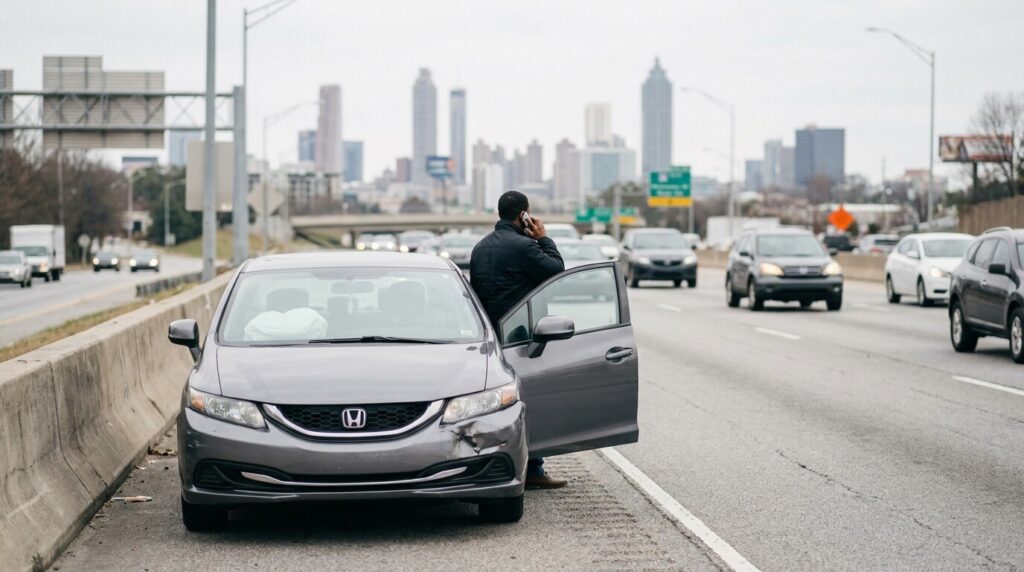
Your First Steps After a Car Crash in Atlanta Can Shape Your Entire Claim
A car accident in Atlanta can leave you shaken and unsure what to do next. The steps you take immediately following a collision directly affect your ability to recover compensation for medical bills, lost wages, and pain and suffering. Georgia operates on an at-fault system, meaning you must prove the other motorist’s negligence caused the wreck. Knowing what to do right after a crash helps protect your health, preserve critical evidence, and avoid mistakes insurers may use against you.
If you were recently hurt in a car wreck, The Law Offices of Darwin F. Johnson can help you understand your rights and next steps. Call 404-521-2667 or reach out online to discuss your situation today.

Why Stopping at the Scene Is Required by Georgia Law
Georgia law imposes a legal duty on every driver involved in a crash resulting in injury, death, or property damage to immediately stop at the scene. Under O.C.G.A. § 40-6-270, drivers must stop without unnecessarily obstructing traffic. This means pulling to a safe shoulder or nearby parking area when possible. Failing to stop is a criminal offense known as hit-and-run, carrying serious penalties.
What Stopping Properly Looks Like
Turn on your hazard lights, move your vehicle out of active traffic lanes if safe, and remain at the scene until you have exchanged information and law enforcement has arrived. Leaving before fulfilling your legal obligations could result in criminal charges. Even if the collision seems minor, remaining at the scene protects your legal position.
💡 Pro Tip: Keep a small emergency kit in your vehicle that includes a phone charger, a pen, paper, and a disposable camera or portable battery pack. These items can be invaluable when you need to document a crash scene and your phone battery is low.
Call 911 and Report the Accident
Under O.C.G.A. § 40-6-273, you must report any accident involving injury, death, or property damage to an apparent extent of $500 or more. Most collisions in Atlanta easily exceed that threshold. The Atlanta Police Department responds to automobile wrecks with injuries within city limits, and the responding officer creates an official accident report that becomes key evidence for any future claim.
Why the Police Report Matters for Your Injury Claim
An official police report documents the time, location, weather, road conditions, and the officer’s observations about fault. Insurance companies rely heavily on this report when evaluating claims. Without one, disputes over who caused the collision become much harder to resolve. If physically able, provide the officer with an accurate account of what happened, but avoid speculating about uncertain details.
💡 Pro Tip: Ask the responding officer for the report number before leaving the scene. You will need this number to obtain a copy of the accident report, which your attorney and insurance company will request during the claims process.
Protect Your Claim by Watching What You Say
Statements you make at the scene can follow you throughout the entire claims process. Saying "I’m fine" or "I don’t need a hospital" can undermine later injury claims. Similarly, apologizing or saying "I’m sorry" gives the other driver or their insurer ammunition to deny or reduce responsibility.
Words That Can Hurt Your Case
Insurance adjusters look for any reason to minimize or deny your claim, and your own words are among their most effective tools. Stick to factual statements when speaking with the other driver and police. You do not owe detailed medical assessments to anyone at the scene. Politely decline to discuss fault or injuries in detail until consulting with a personal injury lawyer.
- Avoid saying "I’m fine" or "It’s not that bad" even if you feel okay initially.
- Do not apologize or accept blame for any part of the collision.
- Limit conversations with the other driver to exchanging insurance and contact information.
- Do not give recorded statements to any insurance company without legal guidance.
💡 Pro Tip: Adrenaline can mask pain for hours or even days after a crash. Many serious injuries, including soft tissue damage and concussions, do not present immediate symptoms. Always seek medical evaluation regardless of how you feel at the scene.
Document Everything at the Crash Scene
If physically able, take photographs of the vehicles and scene. Images showing the type of collision, rear-end, T-bone, or head-on, are critical. Photograph airbag deployment, visible damage, skid marks, road signage, and any debris. These details help establish the force and speed of the collision.
What to Photograph and Why
Visual evidence captured at the scene is difficult to dispute later. Take wide-angle shots showing vehicle positions relative to the intersection or roadway, plus close-up images of damage to each vehicle. If witnesses are nearby, politely ask for their contact information. Witness testimony can corroborate your account if liability is disputed.
| What to Document | Why It Matters |
|---|---|
| Vehicle damage (all angles) | Shows collision type and force of impact |
| Airbag deployment | Indicates severity of the crash |
| Road signs and signals | Establishes traffic rules at the location |
| Skid marks and debris | Helps reconstruct how the crash occurred |
| Your visible injuries | Creates a time-stamped record of harm |
| Weather and road conditions | May support or refute claims about cause |
Understanding Georgia’s At-Fault Insurance System
Georgia personal injury claims require the victim to prove that the other driver’s negligence caused the accident and resulting injuries. This at-fault system means the burden of proof falls on you. Gathering strong evidence at the scene, seeking prompt medical care, and keeping detailed records all strengthen your position.
Filing a Claim After a Car Accident in Atlanta
You generally have two options: filing a claim against the at-fault driver’s liability insurer or filing under your own collision coverage. If the at-fault driver’s insurer delays, Georgia law may allow you to provide notice directly to that insurer.
Georgia requires minimum liability limits of 25/50/25 coverage ($25,000 per person, $50,000 per accident for bodily injury, and $25,000 for property damage). Uninsured and underinsured motorist coverages are not mandatory, but insurers must offer them. The at-fault driver may not carry enough insurance to cover your losses.
💡 Pro Tip: If your vehicle is undrivable after a crash, you may be entitled to reasonable rental or transportation expenses while your claim is being resolved, depending on your policy and the circumstances of the accident.
Know Your Deadline: Georgia’s Statute of Limitations
Under O.C.G.A. § 9-3-33, actions for injuries to the person must be brought within two years after the right of action accrues. For most car accident cases in Atlanta, you have two years from the date of the crash to file a personal injury lawsuit. Missing this deadline generally bars you from pursuing compensation through the courts.
Exceptions Are Narrow
While certain circumstances may toll or extend the statute of limitations, Georgia courts interpret these exceptions narrowly. Tolling may apply when the injured person is a minor or legally incapacitated. Do not assume exceptions automatically apply. Consulting with an Atlanta car accident attorney early ensures you do not miss critical filing deadlines.
💡 Pro Tip: The two-year clock typically starts on the date of the accident, not when you discover the full extent of your injuries. Acting promptly gives your legal team more time to investigate, gather evidence, and build a stronger case on your behalf.
What an Experienced Personal Injury Lawyer Can Do for Atlanta Accident Victims
An attorney familiar with Georgia personal injury law can handle communications with insurers, investigate the crash, and pursue the full range of damages you may be owed. This includes economic damages like medical expenses and lost wages, plus non-economic damages like pain and suffering. Having legal representation early prevents costly mistakes, such as accepting a lowball settlement or missing a filing deadline.
If you are unsure of your next steps, reviewing a detailed guide on what to do after an automobile accident can help you organize your priorities.
Frequently Asked Questions
1. Do I have to call 911 after every car accident in Atlanta?
When Is Calling 911 Legally Required?
Under O.C.G.A. § 40-6-273, you must report any accident involving injury, death, or property damage to an apparent extent of $500 or more. Because most collisions exceed this amount, reporting is almost always necessary. The police report serves as important evidence for your claim.
2. What should I avoid saying at the scene of a crash?
Statements That May Weaken Your Claim
Avoid phrases like "I’m fine" or "I’m sorry," as these can be used against you later. Insurance companies may interpret such statements as admissions that you were not injured or that you accepted fault. Stick to exchanging basic information and providing factual details to the officer.
3. How long do I have to file a personal injury lawsuit after a car wreck in Georgia?
Georgia’s Two-Year Filing Deadline
Under O.C.G.A. § 9-3-33, you generally have two years from the date of the accident to file a personal injury action. Courts interpret exceptions to this deadline narrowly, so acting promptly is important. Consulting with a car wreck lawyer in Georgia early helps protect your right to seek compensation.
4. Can I file a claim with my own insurance if someone else caused the accident?
Using Your Own Policy After a Crash
Yes, Georgia law allows you to file under your own collision coverage even when another driver caused the collision. This can help you get your vehicle repaired or replaced more quickly. You may still pursue a separate claim against the at-fault driver’s insurer for bodily injury and other damages.
5. What if the at-fault driver does not have enough insurance?
Dealing With Underinsured Drivers
Georgia’s minimum liability coverage may not cover serious injuries. While insurers must offer uninsured and underinsured motorist coverage, policyholders may decline it in writing. If the at-fault driver carries only minimum coverage, your own underinsured motorist policy may help bridge the gap. Reviewing your policy with an injury lawyer near me in Atlanta can clarify available coverage options.
Take Action to Protect Your Rights After an Atlanta Car Crash
The decisions you make in the first hours and days after a car accident can significantly impact your ability to recover fair compensation. From stopping at the scene and calling 911 to documenting damage and watching what you say, each step plays a role in building a strong personal injury claim. Georgia’s at-fault system places the burden on you to prove the other driver’s negligence, and the two-year statute of limitations means time matters.
If you or a loved one has been injured in a car crash, The Law Offices of Darwin F. Johnson is ready to help you understand your options. Call 404-521-2667 or contact us today to start the conversation about your claim.