

Understanding Your Paycheck After a Workplace Injury in Atlanta
Key Takeaways: Injured Atlanta workers do not receive their full pay under Georgia workers’ compensation but are entitled to wage replacement based on their average weekly wage. Temporary total disability generally pays two-thirds of your average weekly wage, capped at $800.00 per week for accidents on or after July 1, 2023, while temporary partial disability pays two-thirds of the wage difference, capped at $533.00 per week for up to 350 weeks. Benefits typically begin only after you miss more than seven days of work, with the first week paid only if your absence exceeds 21 consecutive days. Non-catastrophic benefits are generally limited to 400 weeks, while catastrophic injuries may qualify for extended benefits. To protect your claim, report your injury within 30 days and file Form WC-14 within one year. Consulting an experienced Georgia workers’ compensation attorney can help you challenge denials or underpayments.
Injured Georgia workers do not receive their full pay through workers’ compensation, but they are entitled to meaningful wage replacement. If you were hurt on the job in Atlanta, Georgia law provides income benefits designed to replace a portion of your lost earnings while you recover. The most common form, temporary total disability, generally replaces two-thirds of your average weekly wage rather than your full pre-injury paycheck. Understanding how these benefits are calculated, when they begin, and how long they last can help you protect your financial stability.
The team at The Law Offices of Darwin F. Johnson is ready to help you understand your rights. Call our office at 404-521-2667 or reach out through our online consultation request to discuss your situation. Acting quickly helps preserve both your health and your claim.
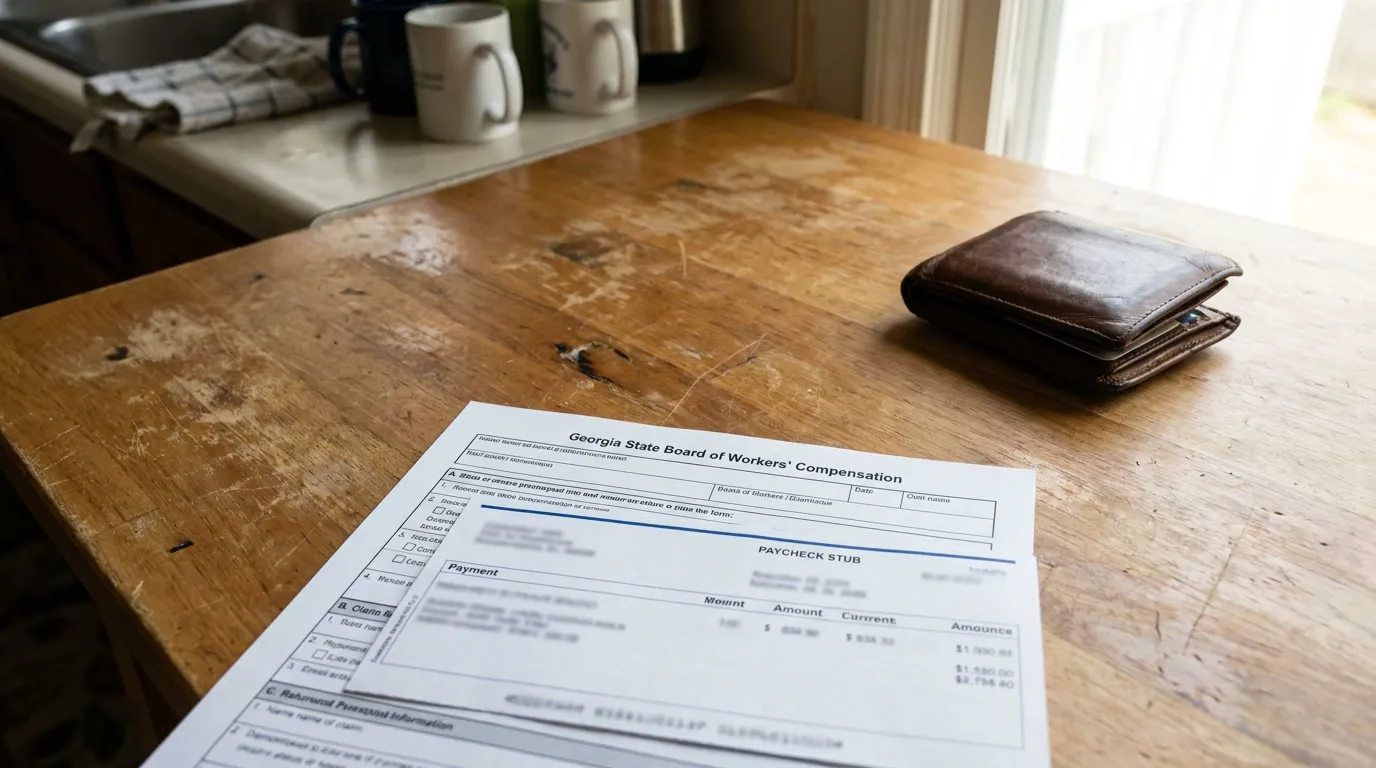
If I Get Injured at Work Do I Get Paid in Georgia?
The short answer is that you may be paid, but not at your full salary. Under Georgia’s workers’ compensation system, wage benefits are intended to partially replace lost income, not duplicate your regular earnings. This is a common misunderstanding among injured workers.
For temporary total disability, the governing statute provides that while the disability to work resulting from an injury is temporarily total, the employer shall pay a weekly benefit equal to two-thirds of the employee’s average weekly wage. If you cannot work at all during recovery, you can generally expect roughly two-thirds of your typical wage, subject to important limits.
Georgia’s rules are set out primarily in O.C.G.A. § 34-9-261 and related provisions. You can review the framework through the state’s official resources on Georgia workers’ comp wage benefits, which outline how income benefits are structured. Because outcomes depend on your specific facts, these rules should be viewed as a general starting point.
💡 Pro Tip: Keep copies of your pay stubs from the weeks before your injury. These records often become critical evidence when an insurer calculates your average weekly wage.
How Georgia Calculates Your Weekly Wage Benefits
Your benefit amount depends on your average weekly wage and the type of disability you experience. Georgia recognizes different categories of income benefits, each calculated differently and capped at statutory limits. The distinction between total and partial disability matters greatly for wage replacement.
Temporary Total Disability Benefits
Temporary total disability applies when you cannot work at all during recovery. This benefit equals two-thirds of your average weekly wage. However, there is a firm ceiling and floor. The statute states the benefit shall be not more than $800.00 per week nor less than $50.00 per week, except that when the weekly wage is below $50.00, the employer shall pay a weekly benefit equal to the average weekly wage.
This cap means higher earners feel the shortfall most acutely. The state-set maximum weekly benefit is $800.00 per week for accidents on or after July 1, 2023. A worker earning $2,000 per week would mathematically qualify for more, but the statutory cap limits the payment.
Temporary Partial Disability Benefits
Temporary partial disability applies when you return to work but earn less than before because of your injury. This is common when a worker resumes lighter duties at reduced hours or a lower rate. Under O.C.G.A. § 34-9-262, the employer pays a weekly benefit equal to two-thirds of the difference between the average weekly wage before the injury and the average weekly wage the employee is able to earn thereafter but not more than $533.00 per week for a period not exceeding 350 weeks.
This benefit helps bridge the gap between your old and new earnings, but it too is capped. Workers returning to lower-paying jobs receive a reduced benefit for a maximum of 350 weeks that will not exceed $533.00 per week if the accident occurred on or after July 1, 2023.
Determining Your Average Weekly Wage
Your average weekly wage is the foundation for every benefit calculation. Georgia normally looks at your earnings during the thirteen weeks before your injury. Under O.C.G.A. § 34-9-260(1), if you worked substantially the whole period, the average weekly wage shall be one-thirteenth of the total amount of wages earned in such employment during the 13 weeks.
When that method does not fit, the law provides alternatives. If the worker had not been employed long enough for the 13-week method, Georgia uses the wages of a similar employee in the same employment, and if that cannot fairly apply, the full-time weekly wage of the injured employee is used instead. These fallback methods matter for newer employees and seasonal workers.
| Benefit Type | Rate | Weekly Cap | Duration Limit |
|---|---|---|---|
| Temporary Total Disability | Two-thirds of average weekly wage | $800.00 | Up to 400 weeks (non-catastrophic) |
| Temporary Partial Disability | Two-thirds of wage difference | $533.00 | Up to 350 weeks |
Timing Rules: When Wage Benefits Start and Stop
Wage benefits do not begin on the first day you miss work. Georgia imposes a waiting period before income benefits are triggered. Understanding this timing helps you plan for the gap between your injury and your first check.
Benefits generally begin after you miss more than seven days of work. According to state guidance, you are entitled to weekly income benefits if you are unable to work for more than 7 days, your first check should be mailed within 21 days after the first day you missed work, and if you miss more than 21 consecutive days, you will be paid for the first week. The initial seven days are only paid retroactively if your absence stretches beyond three weeks.
There are also outer limits on how long benefits last. Temporary total disability benefits are generally payable for a maximum period of 400 weeks from the date of injury, except in the event of a catastrophic injury, where benefits are paid until the employee undergoes a change in condition for the better. The distinction between catastrophic and non-catastrophic injuries can significantly affect the long-term value of a claim.
💡 Pro Tip: Mark your calendar the day you report your injury. Tracking the 21-day window helps you spot delays and follow up if a payment does not arrive on time.
Protecting Your Right to Wage Replacement in Georgia
Preserving your benefits depends on meeting Georgia’s reporting and filing deadlines. Even a strong claim can be jeopardized by missed procedural steps, so prompt action is essential.
Two deadlines deserve special attention:
- Report your injury quickly. State guidance warns that if you wait longer than 30 days to report, you may lose your benefits.
- File your claim in time. You generally must file a claim with the State Board of Workers’ Compensation within one year from the date of your accident by filing Form WC-14.
Compensation for temporary partial or temporary total disability under the workers’ compensation law affects entitlement to state unemployment benefits, meaning the two forms of wage replacement are coordinated rather than stacked. This coordination prevents double recovery.
If your claim is denied or your payments seem too low, working with an experienced Georgia workers’ compensation lawyer can help you challenge improper denials and underpayments. Insurers sometimes miscalculate the average weekly wage or dispute whether an injury arose out of employment. Careful medical documentation and witness statements can strengthen your position.
💡 Pro Tip: Request a copy of the wage statement the insurer used to set your benefit rate. Errors in that calculation are a frequent and correctable source of underpayment.
Frequently Asked Questions
-
How much of my paycheck will workers’ comp replace?
Georgia generally replaces two-thirds of your average weekly wage for temporary total disability, subject to a statutory maximum. Higher earners typically receive less than two-thirds of their actual pay due to the cap. -
If I get injured at work do I get paid for the first week I miss?
Not automatically. The first seven days are only paid if you remain out of work for more than 21 consecutive days. -
What happens if I return to a lower-paying job?
You may qualify for temporary partial disability, which pays two-thirds of the difference between your old and new wages, capped at $533.00 per week for up to 350 weeks. -
How long can I receive wage benefits in Georgia?
For non-catastrophic injuries, benefits are generally limited to 400 weeks from the date of injury. Catastrophic injuries may qualify for extended benefits until a change in condition for the better. -
What deadlines do I need to meet to protect my claim?
Report your injury within 30 days and file Form WC-14 within one year of your accident. Missing these deadlines can jeopardize your benefits.
What Injured Atlanta Workers Should Take Away
Georgia workers’ compensation provides valuable wage replacement, but it does not restore your full pay. Whether you receive temporary total or temporary partial disability, benefits are calculated as two-thirds of your wages and limited by statutory caps and time restrictions. Knowing how your average weekly wage is determined, when payments begin, and how long they continue puts you in a stronger position to protect your income. Understanding the full range of available workers’ comp benefits in Georgia can help you make informed decisions. You can also review the statutory framework through the Georgia workers’ compensation code for additional context.
If you have been hurt on the job and want to understand whether you are being paid fairly, The Law Offices of Darwin F. Johnson is ready to help. Contact our team through our Atlanta injury consultation page, call 404-521-2667, or visit us online today to discuss protecting your wage benefits. Taking action now can help safeguard both your recovery and your financial future.