
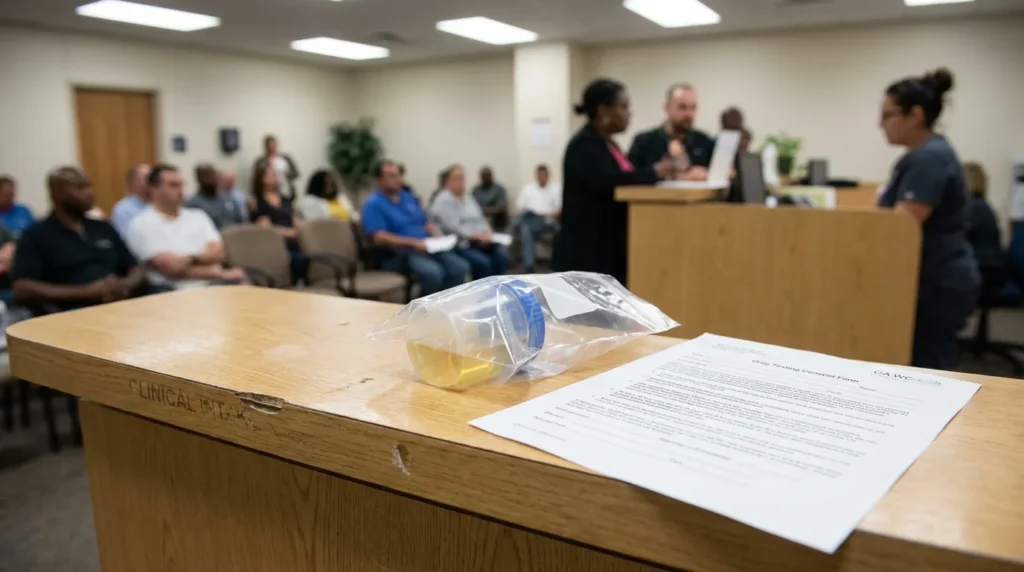
When a Positive Drug Screen Threatens Your Georgia Work Injury Claim
Key Takeaways: OCGA 34-9-17 bars workers’ compensation benefits for injuries caused by willful misconduct or intoxication from alcohol, marijuana, or controlled substances. The statute creates three rebuttable presumptions: blood alcohol of 0.08 grams or greater tested within three hours, any detectable marijuana or controlled substance within eight hours, and unjustified refusal to submit to testing per OCGA 34-9-415. These presumptions shift the burden to the injured worker to prove by clear, positive, and uncontradicted evidence that intoxication did not cause the accident. Medication lawfully prescribed by a physician and taken as directed may fall outside the intoxication bar with proper documentation. Denials may be contestable when samples fall outside statutory windows, chain-of-custody is flawed, or an independent hazard caused the injury.
If you were hurt on the job in Atlanta and your employer sent you for a post-accident drug screen, that test result may shape your entire claim. OCGA 34-9-17 is the Georgia workers’ compensation statute that lists grounds for denying benefits, including willful misconduct and injuries caused by alcohol, marijuana, or controlled substances. Understanding how the ocga 34-9-17 workers comp drug test rules operate can be significant to your claim.
If an insurer has raised intoxication to deny your benefits, you do not have to face that fight alone. The Law Offices of Darwin F. Johnson represents injured workers across metro Atlanta. Call 404-521-2667 or contact us now to discuss your situation.

The Text and Purpose of Georgia’s Denial Statute
OCGA 34-9-17 functions as the exclusions provision of Georgia’s workers’ compensation system. Subsection (a) bars compensation for injury or death due to the employee’s willful misconduct, including intentionally self-inflicted injury, injury from attempting to injure another, or willful failure to use a safety appliance or perform a statutory duty. Georgia courts have construed willful misconduct to require more than ordinary carelessness or momentary lapse.
Subsection (b) contains the intoxication defense. It bars benefits for injury or death due to intoxication by alcohol or being under the influence of marijuana or a controlled substance, except medication lawfully prescribed by a physician and taken in accordance with that prescription. You can review the full statutory language of this Georgia workers comp statute. The prescription exception matters because many positive screens involve doctor-ordered medication.
How the ocga 34-9-17 workers comp drug test Presumptions Work
The statute creates three rebuttable presumptions, each triggered by a different testing scenario. A presumption shifts the burden onto the injured worker to show by clear, positive, and uncontradicted evidence that intoxication did not cause the accident.
| Trigger | Testing Window | Legal Effect |
|---|---|---|
| Blood alcohol concentration of 0.08 grams or greater, per OCGA 34-9-17(b)(1) | Chemical analysis of blood, urine, breath, or other bodily substance within three hours of the alleged accident | Rebuttable presumption that the accident and injury or death were caused by consumption of alcohol |
| Any amount of marijuana or a controlled substance, per OCGA 34-9-17(b)(2) | Within eight hours of the alleged accident | Rebuttable presumption that the accident and injury or death were caused by that ingestion |
| Unjustified refusal to submit to a reliable scientific test, per OCGA 34-9-17(b)(3) | Test performed as set forth in OCGA 34-9-415 | Rebuttable presumption that the accident and injury or death were caused by alcohol or drugs |
The marijuana and controlled substance presumption is often the harshest. Unlike the alcohol rule’s specific 0.08 gram threshold, subsection (b)(2) may be triggered by any amount of marijuana or a controlled substance shown by a qualifying test within eight hours. Controlled substances are defined by reference to OCGA 16-13-21(4), OCGA 16-13-25 through 16-13-29 (Schedules I through V), and 21 C.F.R. Part 1308. Because metabolites can remain detectable long after any impairing effect has ended, a positive result may not establish actual impairment at the moment of injury.
Refusing a Test Carries the Same Risk as Failing One
An unjustified refusal to submit to a reliable scientific test performed as set forth in OCGA 34-9-415 may trigger the same presumption as a positive result. Injured workers sometimes decline a screen out of frustration or confusion, not realizing the statutory consequence. The word "unjustified" leaves room for argument in limited circumstances, such as medical inability to provide a sample, but that determination is fact-dependent.
The Presumptions Are Rebuttable, Not Conclusive
Georgia law expressly labels these presumptions rebuttable, allowing an injured worker to present evidence that intoxication did not cause the accident. Subsection (c) provides that, except for the rebuttable presumptions, the burden of proof is on the party claiming a forfeiture, typically the employer or insurer. To rebut a presumption, the injured worker must meet the higher standard of clear, positive, and uncontradicted evidence. Rebuttal evidence may include chain-of-custody problems, testing outside the statutory window, confirmatory testing errors, eyewitness testimony about normal behavior, or proof that an independent hazard caused the injury.
Lawful Prescriptions and the Statutory Exception
Medication lawfully prescribed by a physician and taken in accordance with that prescription may fall outside the intoxication bar. This exception is written into the statute but is not self-executing. A worker generally needs documentation showing the prescribing physician, dosage directions, and adherence to those directions.
💡 Pro Tip: If you take prescribed medication, keep a current copy of the prescription and pharmacy label accessible. Producing it promptly after a work injury may help address a drug test denial in Georgia before the insurer builds its file around the positive result.
What Typically Happens After a Positive Screen in Atlanta
In many cases, the insurer issues a denial notice citing intoxication and stops medical and wage benefits while the dispute is litigated. Workers in construction, trucking, warehouse and logistics, poultry processing, and manufacturing see post-accident testing most often. A denial at this stage is an administrative position, not a court judgment, and may be challenged by requesting a hearing through the State Board of Workers’ Compensation.
Timing pressure compounds the problem. Georgia generally requires notice of injury within 30 days, and under OCGA 34-9-82 a claim generally must be filed within one year of the accident, subject to limited exceptions such as tolling rules that can apply when the employer has furnished remedial treatment or paid weekly benefits.
- Report the injury to a supervisor in writing as soon as possible and keep a copy.
- Note the exact time of the accident and sample collection.
- Identify coworkers who observed you before and after the injury.
- Preserve prescription records, discharge paperwork, and testing consent forms.
- Avoid speculating about impairment in recorded statements to an adjuster.
Why Intoxication Denials Are Frequently Contestable
A positive test alone may not end a claim under Georgia’s workers compensation intoxication law. The presumptions depend on specific conditions: the correct testing window, a qualifying analytical method, and, for alcohol, a specific concentration. When an employer collects a sample outside the statutory window, or when testing does not meet the statutory framework, the presumption may not attach.
Causation generally remains the central legal question. Even where a presumption applies, the statutory bar reaches injuries "due to" intoxication, not every injury coinciding with a positive screen. Intoxication denials are one of several reasons why a claim may get denied, and outcomes turn on the evidentiary record rather than the test result alone.
💡 Pro Tip: Request a copy of the laboratory report and chain-of-custody documentation early. Confirmatory testing details may reveal whether the sample was handled consistent with statutory requirements.
Building a Record That Answers the Intoxication Defense
Because these disputes are fact-driven, the strength of your evidence can significantly influence the result. Medical records documenting the mechanism of injury, incident reports, safety complaints about equipment or staffing, and testimony from supervisors about your conduct that day may all bear on causation. An experienced atlanta workers comp lawyer can evaluate whether the presumption applies and what rebuttal evidence exists.
Georgia’s system is procedurally distinct from a civil lawsuit. Workers’ compensation claims proceed administratively before the State Board of Workers’ Compensation, and workers’ compensation is generally the exclusive remedy against the employer.
Frequently Asked Questions
1. Does a positive marijuana test automatically bar my Georgia workers’ comp benefits?
Not automatically. Under OCGA 34-9-17(b)(2), any amount detected within eight hours may create a rebuttable presumption of causation, meaning you may present clear, positive, and uncontradicted evidence that the ingestion did not cause your injury. Success depends on the specific facts and evidence.
2. What if my prescription medication caused the positive result?
OCGA 34-9-17(b) excepts substances lawfully prescribed by a physician and taken in accordance with that prescription. You will generally need documentation of the prescription and directions, as the laboratory report alone may not distinguish lawful from unlawful use.
3. Can I refuse a post-accident drug or alcohol test?
Refusing carries significant risk. OCGA 34-9-17(b)(3) provides that an unjustified refusal creates a rebuttable presumption that alcohol or drugs caused the injury or death. Whether a refusal was justified is generally decided on individual circumstances.
4. Who has to prove intoxication in a Georgia claim?
Under OCGA 34-9-17(c), except for the rebuttable presumptions, the burden of proof is on the party claiming a forfeiture, typically the employer or insurer. When a presumption attaches, the burden shifts to the injured worker to rebut it with clear, positive, and uncontradicted evidence.
5. What alcohol level triggers the presumption?
OCGA 34-9-17(b)(1) sets the threshold at a blood alcohol concentration of 0.08 grams or greater, established by chemical analysis conducted within three hours of the alleged accident.
Protecting Your Claim After a Work Injury and Drug Screen
OCGA 34-9-17 gives employers and insurers real tools to contest claims, from willful misconduct exclusions to the intoxication defense and its three rebuttable presumptions. Those presumptions, however, are conditional, time-limited, and open to rebuttal, and the statute places the general burden of proving a forfeiture on the party asserting it. If you are facing a drug test denial in Georgia, the record you build in the first days after your injury can matter as much as the test result itself.
If an intoxication defense is being used to deny your benefits, reach out to The Law Offices of Darwin F. Johnson for a review of your claim. Call 404-521-2667 or schedule a consultation to learn about your options under Georgia law.
Disclaimer: This content is for informational purposes only and is not legal advice. Every case is unique, and results may vary. Consult an attorney about your specific circumstances.